

SOLO Wilderness First Aid (WFA) Certification — 2-Day Course
SOLO Wilderness First Aid (WFA) Certification — 2-Day Course
Choose Date and Location:
Choose Options:
Couldn't load pickup availability
Wilderness First Aid Course — SOLO WFA Certification
Build real, usable medical skills for the backcountry with the SOLO Wilderness First Aid (WFA) Certification — a two-day, 16-hour hands-on training designed for anyone who spends time in remote environments. This SOLO wilderness first aid course teaches you how to assess, treat, and make sound decisions for sick or injured patients when definitive medical care is hours away.
Upon successful completion, students earn a two-year SOLO Wilderness First Aid (WFA) certification, a two-year BLS/CPR certification, and an ACS Stop the Bleed certification. For eligible students, this course may also serve as a Wilderness First Responder (WFR) recertification under current SOLO policies.
Why This SOLO Wilderness First Aid Course
This wilderness first aid course uses the recognized SOLO curriculum from the oldest continuously operating school of wilderness medicine in the world. SOLO's WFA program aligns with modern wilderness medicine standards and is accepted by employers, outfitters, and guide services across the industry. The course runs 16 hours over two days — focused, efficient, and built around hands-on patient scenarios with moulaged casualties that force you to apply what you learn under realistic stress. You will walk away with a repeatable assessment process, clear treatment priorities, and the ability to decide when to treat in place, when to evacuate, and how — using both dedicated medical gear and the equipment you already carry.
What You'll Learn
Response and Patient Assessment
Students learn scene safety, standard precautions, and how to understand the anatomy of a crisis in the backcountry. The course covers step-by-step patient assessment in remote settings, using SOAP notes for clear documentation and handoff, patient lifting and moving without compounding injuries, and recognizing and treating shock before it becomes life-threatening.
Musculoskeletal Injuries
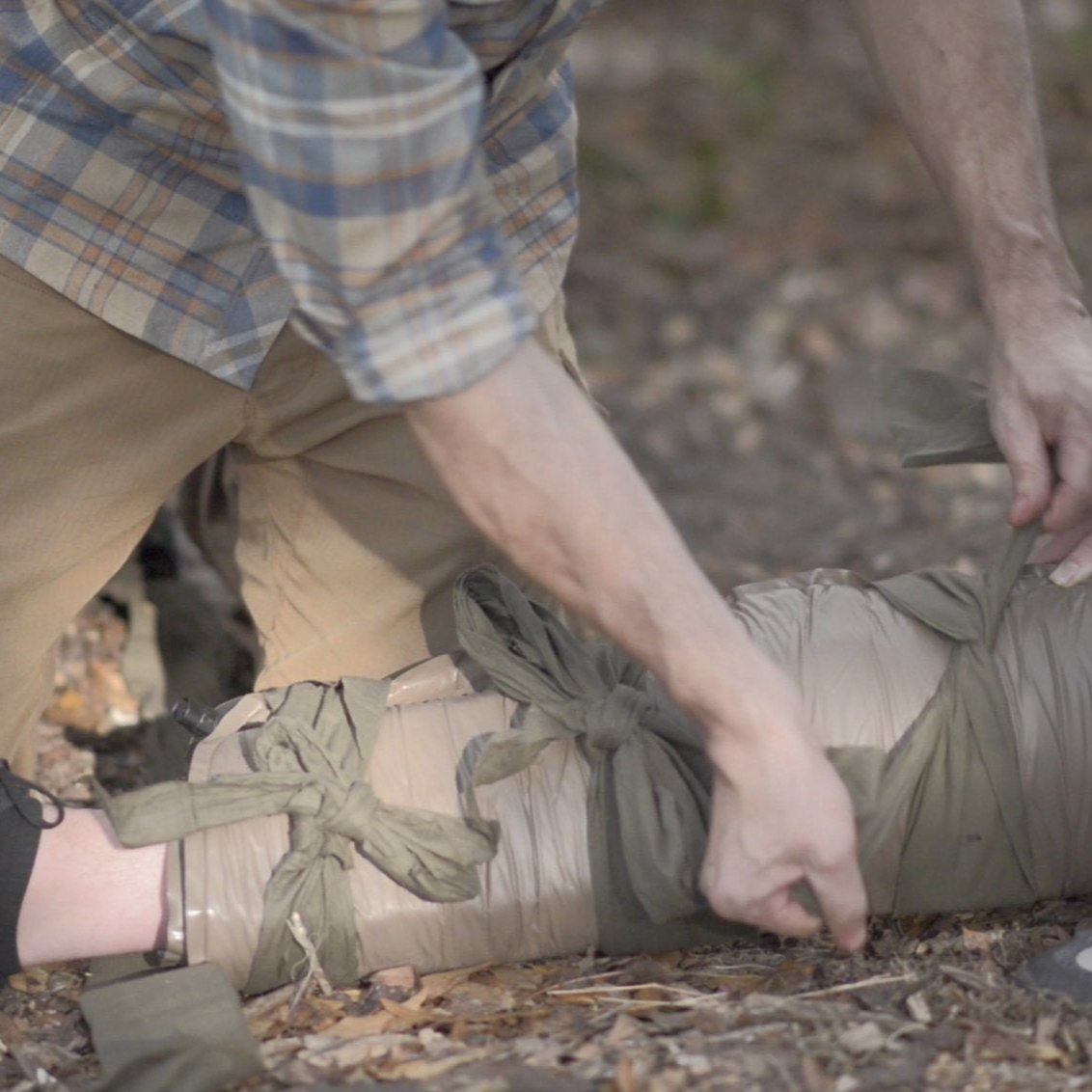
Students work through how the musculoskeletal system fails in the field — differentiating sprains, strains, and fractures, building effective improvised splints with common outdoor gear, and recognizing mechanisms and signs of possible spine involvement to initiate basic spine protection.
Environmental Emergencies
This section covers how the human body responds to heat, cold, stress, and exertion. Students learn to recognize and manage cold-related injuries including hypothermia and frostbite, heat illness including dehydration, heat exhaustion, and heat stroke, bites and stings from common North American species, and lightning and drowning incidents in the field. Simple bivouac and survival skills that support good medical outcomes are also covered.
Soft Tissue Injuries
Students learn to stop bleeding with direct pressure, wound packing, and pressure dressings, clean and irrigate wounds to reduce infection risk, apply bandaging that stays in place during movement, recognize and manage wound infections in remote areas, and provide basic burn care in the field.
Medical Emergencies
The course covers recognizing changes in level of consciousness and what they indicate, breathing problems including asthma, respiratory distress, and allergic reactions, signs and symptoms of chest pain and cardiac events, and making sound evacuation decisions with limited tools when help is hours away.
Scenario-Based Practice
Throughout the course, students rotate between patient, rescuer, and observer — practicing scene management and leadership under stress, team communication in noisy, chaotic, or low-light environments, and improvised solutions using only what is in your pack or immediately around you. This is where the course comes alive and where confidence is actually built.
Instructor Cadre
Primary Instructor — Rick Swain
Rick Swain is a former Army combat veteran with more than 20 years of experience as a Special Operations Combat Medic and Paramedic/HAZMAT Technician, serving in technical and tactical units in Iraq, Afghanistan, Panama, Ecuador, and other austere environments. After his military career, he mentored and evaluated National Guard CBRN response units and trained at multiple outdoor and wilderness schools — including GB2 and SOLO — before becoming a registered Maine Guide and certified SOLO Wilderness Medicine Instructor. Rick brings hard-earned experience and a direct, practical teaching style to every course.
Additional Instruction — Joshua Enyart
Joshua Enyart, the Gray Bearded Green Beret, is a former Army Ranger and Green Beret with more than three decades of experience as a professional instructor for military and civilian organizations. As founder and head instructor of Gray Bearded Green Beret, he integrates wilderness survival, bushcraft, preparedness, and wilderness medicine into a cohesive system focused on real-world application.
All instructors maintain current WFA/WFR and BLS/CPR credentials at a minimum.
Who Should Take This Course
This WFA certification course is built for people who actually go into the field. It is well suited for day hikers and backpackers who regularly travel on remote trails, skiers, climbers, and paddlers who recreate in rugged environments, hunters and anglers who spend long days far from trailheads, trip leaders, camp staff, and outdoor educators responsible for the wellbeing of others, and anyone who wants a solid foundation in wilderness first aid without yet needing the full Wilderness First Responder certification. For current Wilderness First Responders, this course may also serve as a WFR recertification option depending on SOLO's current policies and your existing certification dates.
Course Details
The SOLO Wilderness First Aid Course is delivered by the GB2 Cadre using SOLO's official WFA curriculum. The course runs two days at approximately 16 training hours. Students who successfully complete the course earn a SOLO Wilderness First Aid (WFA) certification valid for two years, a BLS/CPR certification valid for two years, and an ACS Stop the Bleed certification. The format combines lecture, hands-on skills labs, and realistic wilderness patient scenarios throughout both days.
How This Course Fits the GB2 Curriculum
The SOLO Wilderness First Aid Course is the live course through which the GB2 System of Training™ delivers its wilderness medicine curriculum at the foundation level — using SOLO Schools' nationally recognized certification program. Students looking to advance beyond WFA should consider the SOLO Wilderness First Responder (WFR) Certification — the 8-day advanced certification for those who guide, instruct, or operate in prolonged remote environments. The first two days of the WFR are identical to the WFA, making this course a direct stepping stone. Students who want to pair medical training with foundational field skills will find the GB2 Wilderness Survival Course a natural complement — covering all 8 Survival Priorities in a live outdoor environment. Students who want to build familiarity with wilderness medicine concepts before attending can also explore the Wilderness Medical Course Instructional Series on the GB2 Network — non-certifying, but a solid introduction to the material.
Event Status and Booking
Courses listed as Scheduled are planned events pending minimum enrollment. Once minimum enrollment is reached, status changes to Confirmed and the course is guaranteed to run. Confirmed – Limited indicates only a few seats remain. Students are advised to make travel arrangements only after a course is marked Confirmed. Gray Bearded Green Beret LLC is not responsible for airfare, lodging, rental vehicles, or other travel expenses in the event a Scheduled course does not meet minimum enrollment or must be rescheduled due to circumstances beyond our control.
View all scheduled dates and locations at the Live Training Events & Courses collection.
Frequently Asked Questions
What is SOLO Wilderness First Aid (WFA) and what does the 2-day course cover?
SOLO Wilderness First Aid (WFA) is a nationally recognized certification that prepares you to assess and manage medical emergencies in outdoor settings where EMS response may be delayed and patient preparation for evacuation is required. The 2-day course covers patient assessment systems, hemorrhage control, wound management, fracture and musculoskeletal injury management, spinal injuries, anaphylaxis, hypothermia and heat illness, lightning injuries, improvised evacuation techniques, and the decision-making framework for wilderness medical scenarios. CPR certification is included. The GB2 WFA course runs concurrently with the SOLO Wilderness First Responder (WFR) program — WFA and WFR students share the first two days of training together; WFA students receive their certification upon completion of day two.
Is the SOLO WFA certification nationally recognized?
Yes. SOLO Schools (Stonehearth Open Learning Opportunities) is one of the most respected wilderness medicine training organizations in the country, with over 40 years of curriculum development and a founding role in establishing national wilderness medicine education standards. The SOLO WFA certification is recognized by outdoor industry employers and programs across the country. GB2 partners with SOLO to deliver this curriculum because their standards represent the benchmark in wilderness medicine education.
How is wilderness first aid different from standard first aid or CPR?
Standard first aid and CPR are designed for urban environments where EMS can arrive within minutes. Wilderness first aid addresses outdoor settings where EMS response is delayed — and where patient packaging, field stabilization, and evacuation decision-making become critical responsibilities. The assessment protocols, treatment decisions, and improvised care techniques taught in WFA go significantly beyond standard first aid, equipping you to manage a patient and make sound evacuation calls in environments where you can’t rely on rapid emergency response.
Do I need any prior first aid or medical training to take the WFA course?
No prior medical training is required. The WFA course is designed to be accessible to motivated adults with no medical background. It’s a practical skills course, not a theoretical medical curriculum — the focus is on what you can do in the field with available resources under realistic wilderness conditions.
How long is the SOLO WFA certification valid?
The SOLO WFA certification is valid for 2 years. CPR certification is included with the course. Recertification courses are available through SOLO-affiliated providers, including Gray Bearded Green Beret. For those who want a significantly higher level of wilderness medicine training, the 8-Day SOLO Wilderness First Responder (WFR) certification is also available through GB2. The way GB2 structures these courses, WFA and WFR students train together for the first two days — WFA candidates complete their certification at that point, while WFR candidates continue for six additional days of advanced content. This concurrent structure is specific to how GB2 delivers these programs; other SOLO providers may schedule them differently.
Why does GB2 partner with SOLO for wilderness medicine certification?
Joshua Enyart built the medical component of the GB2 curriculum around real-world standards — not a proprietary credential that inflates the school’s course catalog. SOLO Schools represents the gold standard in wilderness medicine education, and delivering their certification through GB2 ensures students earn a credential with national recognition and real industry standing. The quality of the credential matters as much as the quality of the training.
Share




Collapsible content
Important Notes
This course is a field course that requires students to spend the training day in a remote and primitive setting. There will be limited access to electricity or running water, and restrooms will likely be limited to portable toilets on-site.
However, camping is provided on-site, and students will be allowed to either construct their own shelters or use a tent or hammock system. Students will have access to their vehicles during the course before and after the training day and often for lunch as time permits. You may coordinate for off-site lodging for yourself, but are responsible for being back at training on time the next day. Staff is not responsible for you while off the venue.
It is important to be prepared for harsh weather conditions and embrace the challenging field conditions, including cold, rain, wind, and snow. Safety will be a top priority maintained by the course cadre and staff.
It is essential for students to remain dedicated and engaged throughout the course. We will not give up on you if you do not give up on yourself. However, if a student decides not to continue training or does not participate, they will be immediately escorted back to their vehicles and must leave the training venue. Please note that there will be no refunds or credits for the course, and students may not leave and come back at a later time (with some exceptions determined by the cadre).
Upon arrival, ensure that you are physically prepared for the course and have all the equipment you need.
Participants are responsible for bringing their own food and snacks for the duration of the course. Going off-site to get food will likely be limited to the evenings after training or mornings before training starts. Lunch breaks, when available, will likely be shorter in duration and not long enough to go off-site to eat. Additionally, it is highly recommended to bring electrolyte replacements, either commercial or homemade.