


Bushcraft Course — 3-Day Skills & Field Training
Bushcraft Course — 3-Day Skills & Field Training
Choose Date and Location:
Choose Options:
Couldn't load pickup availability
Note on the June 2026 session: This date runs as our legacy 4-day format. All other scheduled sessions follow the updated 3-day curriculum at a lower price point. Same core instruction — one extra day of field time on the legacy date.
Bushcraft Skills Course — Replacing Gear with Knowledge in the Field
The Gray Bearded Green Beret Bushcraft Skills Course is a 3-day, 2-night intermediate field course that bridges the gap between modern-gear survival and nature-reliant woodsmanship. Where the Wilderness Survival Course teaches you to meet your basic needs with a full kit, the Bushcraft Course begins removing the manufactured components and replacing them with skills and natural materials. Fire without a lighter. Cordage without a spool of paracord. Camp implements without a gear store. The skills taught in this course are old — developed over millennia by people who had no other option — and they are genuinely useful to anyone who spends time in the woods with or without a full kit.
The Core Concept: Knowledge Weighs Nothing
Every bushcraft skill you develop reduces your dependence on gear you might not have. A person who can produce fire with a bow drill has an ignition method that requires no manufactured components — a fundamentally different category of redundancy than carrying a second lighter. A person who can make functional cordage from basswood bark or dogbane doesn't need to worry when their paracord supply runs low. This isn't about going into the woods with no gear — it's about understanding that skill is a category of resource, and unlike physical gear, it weighs nothing and cannot be lost, forgotten, or damaged.
The Bushcraft Skills Course develops that resource systematically, in real field conditions, over three days and two nights. The crawl-walk-run instructional model means every skill is demonstrated, practiced under supervision, and applied independently before moving on. By the end of the course, students have genuine hands-on experience with every technique taught — not just an understanding of how it works in theory.
What You'll Learn Over Three Days
Bow Drill Friction Fire
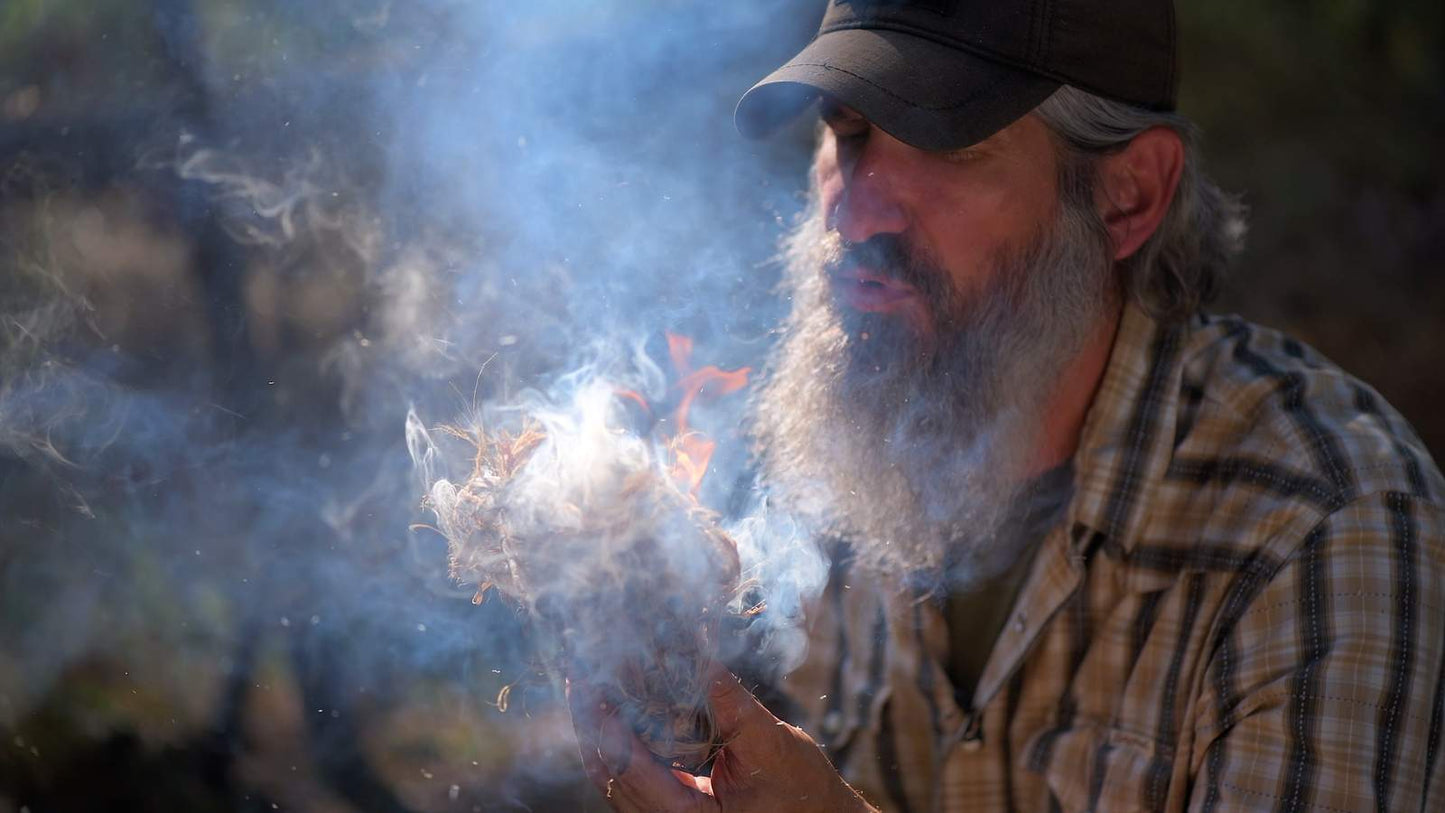
The Bushcraft Course is where students encounter the bow drill for the first time — but the version taught here is deliberate: bow drill with man-made cordage. Joshua calls this a hybrid primitive skill. The cordage is manufactured; everything else — spindle selection, fireboard species, socket management, bow mechanics, coal transfer — is primitive. This is intentional, not a shortcut. Teaching the bow drill on man-made cordage isolates the variables that actually determine whether you produce a coal, so students can build genuine competence in the technique before they have to also make the cordage themselves. That happens at the Primitive Survival Course, where students run the same bow drill on natural cordage they made from plant fiber — no training wheels. The progression works because students arrive at Primitive already owning the mechanical skill. They're only adding one new variable instead of learning everything at once.
Wood species selection for spindle and fireboard, moisture content assessment, bow mechanics, the transfer and blowing sequence, and the ability to diagnose and correct a failing kit in the field — all of it is covered. Students who make fire the first time they try are learning; students who fail a few times and understand why are learning more.
Flint and Steel
Flint and steel is a historical ignition method that sits between fully primitive friction fire and modern manufactured lighters — and it's a legitimate field skill, not just a historical curiosity. Striking a high-carbon steel striker against a piece of flint or quartzite produces a spark that can be caught in a char cloth or natural tinder bundle and blown into flame. The course covers striker technique, appropriate stone selection, char cloth preparation from natural and manufactured materials, and the natural alternatives to char cloth that can function as a spark catcher when you haven't prepared materials in advance. Students leave with working knowledge of the method and an understanding of where it fits in a layered ignition strategy.
Tinder Fungi and Natural Fire-Starting Materials
The ability to produce friction fire or catch a flint-and-steel spark is only half the equation. What you catch that spark in — your tinder bundle — determines whether a fragile coal becomes a fire or dies before you can use it. The course covers two primary tinder fungi in depth: Chaga and Horsehoof fungus. Horsehoof fungus is also the source of amadou — a traditional fire-starting material produced by processing the inner flesh of the fungus, which holds a spark and smolders with exceptional reliability. Students identify these fungi in the field, process them correctly, and understand both how to find them and what to do with them when found. Natural tinder materials from plant fiber, dried bark inner layer, and grasses are also covered, along with the processing techniques — shredding, rubbing, nesting — that convert raw natural material into a functional tinder bundle.
Natural Cordage from Plant Fiber
Cordage is used for everything in a field camp — shelter construction, tool handles, load carrying, lashings, and improvised gear repair. The ability to make functional cordage from plant material means you're never actually out of rope, as long as you can identify and process what the environment provides. The course covers plant fiber cordage in practical detail: identification of appropriate plant sources — dogbane, milkweed, and wisteria are common sources depending on venue location and season — fiber extraction and preparation, and the two-strand reverse-wrap technique that produces strong, functional cordage of any length. Students make and test their own cordage against realistic loads, which builds both competence and an honest sense of what natural cordage can and cannot do compared to manufactured alternatives. Students also learn to combine individual cordage strands into three-strand rope — multiplying both length and load capacity beyond what a single strand produces.
Knots and Lashings
The Bushcraft Course covers the GB2 Knot Progression™ — Joshua’s system for building 15 functional knots from two baseline ties — as a foundation, then adds lashings: multi-wrap configurations that allow you to build rigid structures from poles and natural cordage with a strength that single knots don’t produce. Working with natural cordage rather than nylon introduces a new set of variables — fiber slip, compression under load, tension management — that teaches students to understand how a knot actually works rather than just what it looks like when it's done.
Bushcraft Shelters
Bushcraft shelters are different from emergency survival shelters in one important way: they’re designed to last more than a night. The Bushcraft Course teaches intermediate shelter construction — structures that integrate a tarp with natural ridgelines, support poles, lashings, and debris layering, rather than the fully natural-material shelters reserved for the Primitive course. The course covers shelter construction with a longer-term lens: site selection for durability and weather management, structural systems that combine a tarp with natural materials and lashings, debris techniques for insulation and weatherproofing, and fire management in a camp context where fire placement relative to sleeping areas and shelter openings significantly affects warmth and comfort. Students spend multiple nights in field camps they’ve built themselves.
Green Wood Carving, Tool Skills, and Camp Implements
The Bushcraft Course is the first point in the GB2 curriculum where students work with axes and hatchets — specifically a carving hatchet — along with carving knives and spoon (hook) knives. These are the tools of traditional woodcraft, and the course is structured around learning to use them to produce functional objects from green wood: pack frames, buck saws, cooking implements, and a range of carving projects that build both tool skill and an understanding of wood properties. Students leave the course having made things they can actually use, not just having practiced technique in isolation.
This is where the Bushcraft Course earns its name as a frontier skills course. The tools are real, the projects are real, and the woodcraft knowledge — how wood behaves when green versus dry, how to read grain for carving, how to process timber with hand tools — is the kind of competence that doesn't expire and doesn't require a power source. Safety instruction for each tool category is covered before use, with progression from guided practice to independent work as students demonstrate handling competence.
Instructor Credentials and Safety Infrastructure
The Bushcraft Skills Course was developed by Joshua Enyart — former Army Ranger and Green Beret with three decades of professional instructor experience in field environments. The course reflects Joshua's foundational conviction that traditional skills are genuinely valuable — not as historical artifacts or survival-show theatrics, but as a real category of field competence that changes how a person operates outdoors. Every skill taught in the course is a skill he has used in real conditions, and the curriculum is structured to produce the same functional competence in students.
Safety infrastructure matches every GB2 field course: on-site Medic Station with appropriate medical equipment, dedicated medic and Search and Rescue staff on every event, and all instructors CPR/AED certified and Wilderness First Responder certified at minimum. The course is fully insured.
Prerequisites and Who This Course Is For
The Bushcraft Skills Course is listed as intermediate. Students with foundational wilderness survival knowledge will get the most out of the curriculum — the Wilderness Survival Course is the recommended prerequisite, with the Master Navigator Course as an alternative for students with strong field backgrounds. Neither is required to register. Motivated beginners can enroll and will benefit from the course — they should expect a steeper initial learning curve on the friction fire content in particular.
The course is right for anyone who finds the idea of making fire, cordage, and shelter from natural materials genuinely compelling — hunters, hikers, overlanders, woodsmen, and anyone interested in traditional skills. It's also a required component for students pursuing the GB2 Wilderness Survival Certification, and a direct preparatory course for the Primitive Survival Course where these skills are applied without any modern gear at all.
How This Course Fits the GB2 Curriculum
The Bushcraft Skills Course is the second stage of the GB2 System of Training™ — the bridge between the modern-gear foundation of the Wilderness Survival Course and the knife-only demands of the Primitive Survival Course. Students who complete Bushcraft alongside the Winter Survival, Master Navigator, and Wilderness First Responder courses are working toward the GB2 Wilderness Survival Certification. Full program details are on the Wilderness Survival Certification page.
For students who want to study the underlying survival framework alongside their field training, the Wilderness Survival PDF Series covers 13 study guides built on the same principles. Joshua's field manual Surviving the Wild — 80,000 words of field-tested survival methodology — is used as a primary reference by many GB2 students before and after attending courses.
Event Status and Travel Policy
Courses listed as "Scheduled" are planned events pending minimum enrollment. Once minimum enrollment is reached, the status changes to "Confirmed" and the course is guaranteed to run. "Confirmed – Limited" indicates only a few seats remain. Students are advised to make travel arrangements only after a course is marked Confirmed. Gray Bearded Green Beret LLC is not responsible for airfare, lodging, rental vehicles, or other travel expenses in the event a Scheduled course does not meet minimum enrollment or must be rescheduled due to circumstances beyond our control.
Course Details and Packing List
Duration is 3 days and 2 nights in a field environment, with the June 2026 legacy session running 4 days at a higher price point. Multiple dates and locations are available — check current listings for the schedule nearest you. A full packing list covering required and recommended gear is available for download: Bushcraft Skills Course Packing List. Reviewing the list before registering is recommended — knife selection in particular benefits from some advance consideration.
View all scheduled dates and locations at the Live Training Events & Courses collection.
Frequently Asked Questions
What bushcraft skills are covered in the 3-Day course?
The 3-Day Bushcraft Course covers the foundational skills of traditional woodland craft: fire by friction and natural ignition methods, primitive shelter construction, carving and woodcraft with a knife and axe, natural cordage, foraging for plant materials, camp craft and tool maintenance, and the principles of sustainable fieldcraft. Every skill is hands-on — you'll make fire, build shelter, and work wood under instructor guidance over three days in the field.
Do I need to own specialized bushcraft tools before attending?
The packing list is linked in the product description above — review it before registering. This course uses specialty tools for wood carving, so come prepared. Upon registration you'll also receive the Student Coordination Packet with full logistics and everything you need to prepare.
What is the GB2 philosophy on bushcraft?
At GB2, bushcraft is understood as the bridge between modern and primitive — the skillset that begins teaching you how to replace gear with knowledge and put more emphasis on natural materials. Where survival training focuses on emergency response, bushcraft is about developing a deeper, long-term relationship with the natural environment. It's functional, not aesthetic — every skill taught has roots in traditional woodsmanship and is selected because it works.
How does bushcraft differ from survival training?
Survival training addresses emergency situations — the short-term response to an unplanned wilderness crisis. Bushcraft is the long-form capability to live and thrive in the outdoors indefinitely using traditional skills and natural materials. They overlap significantly: a skilled bushcrafter is a formidable survivor. At GB2, both disciplines share the same principles-first foundation, and students who pursue both develop a more complete wilderness capability.
Is this course appropriate for complete beginners?
Yes. No prior bushcraft or survival training is required. The course is designed to build skills from first principles under direct instructor supervision. Students who arrive with existing knife skills or camp experience will have those skills refined and expanded; complete beginners will develop a solid functional foundation over three days.
Where does the course take place?
Dates and locations are listed in the product options above. Upon registration you'll receive the Student Coordination Packet with full logistics details and everything you need to prepare. GB2 bushcraft courses are conducted in appropriate woodland terrain — real outdoor environments with natural materials, not facilities.
Share



Collapsible content
Important Notes
This course is a field course that requires students to fully immerse themselves in a remote and primitive setting. There will be no access to electricity or running water, and restrooms will likely be limited to portable toilets on-site. Additionally, students will be responsible for constructing their own shelters and will not have access to their vehicles during the course. It is important to be prepared for harsh weather conditions and embrace the challenging field conditions, including cold, rain, wind, and snow. Safety will be a top priority maintained by the course cadre and staff.
It is essential for students to remain dedicated and engaged throughout the course. We will not give up on you if you do not give up on yourself. However, if a student decides not to continue training or does not participate, they will be immediately escorted back to their vehicles and must leave the training venue. Please note that there will be no refunds or credits for the course, and students may not leave and come back at a later time (with some exceptions determined by the cadre).
Upon arrival, ensure that you are physically prepared for the course and have all the required equipment. If you have a preexisting medical condition, please provide a physical from your doctor to GB2 staff for approval to attend the course. If you have any concerns, please contact info@graybeardedgreenberet.com for assistance. Additionally, please disclose any previous hot or cold weather-related injuries (such as heat exhaustion, heat stroke, hypothermia, frostbite, etc.) as they may increase your risk of re-injury.
Participants are responsible for bringing their own food and snacks for the duration of the course. It is important to choose easy-to-prepare meals and on-the-go snacks. Due to time constraints, there will not be a lunch break. Participants are advised to eat breakfast before the start of training, as it will be a long day before time to prepare dinner is provided. Additionally, it is highly recommended to bring electrolyte replacements, either commercial or homemade.