

Tactical Navigator™ Map Reading and Land Navigation Course — 3-Day Training
Tactical Navigator™ Map Reading and Land Navigation Course — 3-Day Training
Choose Date and Location:
Choose Options:
Couldn't load pickup availability
Land Navigation Course — Map Reading and Land Navigation Training
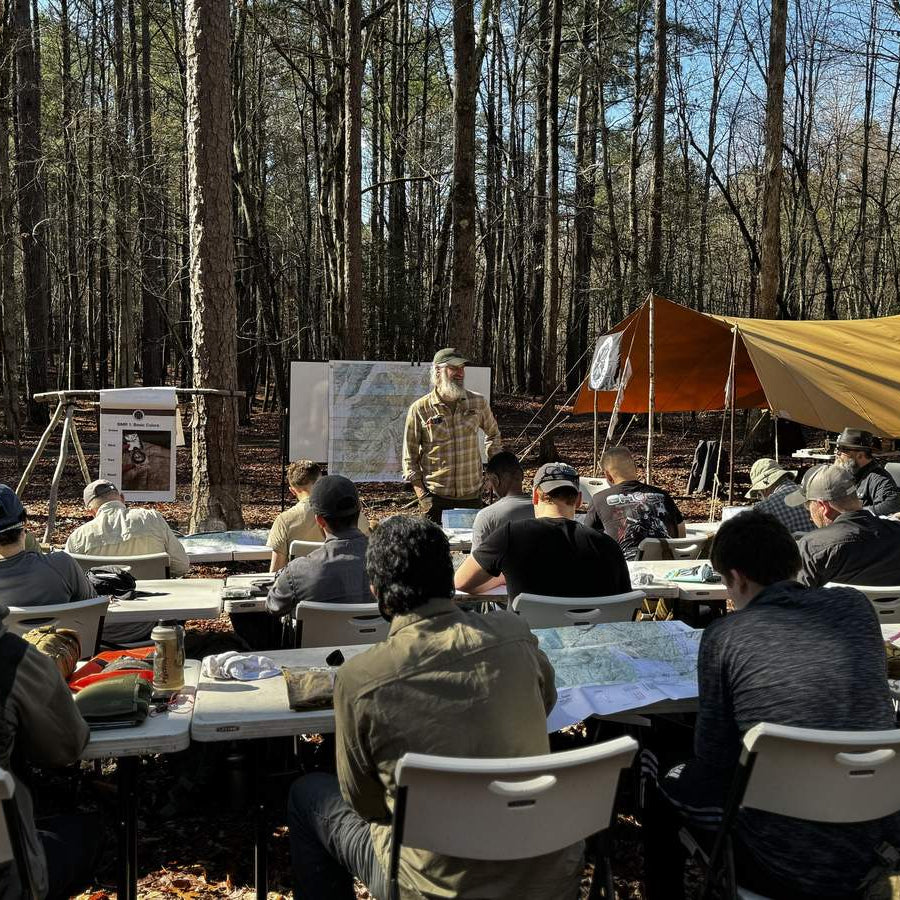
The Tactical Navigator™ Map Reading and Land Navigation Course is a 3-day, 2-night immersive field course covering the complete spectrum of tactical map and compass skills — from basic map anatomy and declination adjustment through terrain association, dead reckoning, and night navigation. This land navigation training was developed and is taught by former Army Ranger and Green Beret Joshua Enyart, and is designed for anyone who wants to learn to effectively and efficiently navigate any terrain, in any conditions, without depending on GPS or a phone signal. This course is meant for anyone preparing for Special Operations Selection Courses that have a heavy navigation assessment component. It is open to military, law enforcement, and civilians alike.

Learn to Survive
Hardcover · Full Color · 430 Pages · by Joshua Enyart
Surviving the Wild is the recommended pre-course reading for GB2 students — 430 full-color pages covering the field survival skills that support extended time in the backcountry, the same environment you'll be navigating through over three days and two nights.
Get the Book →Why Land Navigation Training Matters
Map Reading and Land Navigation is one of the single biggest points of failure for candidates not being selected for Special Operations training. Navigation is the one skill where a single mistake doesn't give you a second chance to correct it. Getting turned around three miles from camp in failing light, or committing to the wrong drainage because you misread a contour line — those situations unfold fast and they compound. What separates the people who handle them from the ones who don't isn't luck or fitness. It's the ability to read ground against a map, stay oriented while moving, and know exactly what to do when the picture stops making sense.
The Tactical Navigator™ Course is that professional navigation training — built on the same structured progression Joshua applied during his service and has taught for three decades since: foundational theory to unsupervised field application, with enough repetition that the skills hold under fatigue and stress, not just in a classroom. You won't leave with a certificate that says you attended a land navigation course. You'll leave with the skills to back it up and be confident in your selection course.
Why Three Days? The Case for Repetition
There are shorter land navigation courses out there. A motivated student can learn the theory of map reading and compass use in a single day. But knowing how something works and being able to do it under pressure, in unfamiliar terrain, in the dark, while tired — those are not the same thing, and no amount of classroom time closes that gap.
The Tactical Navigator™ Course is built around a minimum of seven full navigation lanes that every student must complete. Not demos. Not group exercises where one person navigates and the rest follow. Seven lanes where you are the one with the map, the compass, and the decision. That volume is not padding — it is the point. Navigation becomes a reliable skill through repetition, and repetition takes time. The three-day structure exists because that is genuinely what it takes to make a student good at this, and cutting it short would mean sending people to selection courses with familiarity instead of competence.
What You'll Learn in This Land Navigation Course
The Tactical Navigator™ curriculum follows the same crawl-walk-run instructional model used across the GB2 course lineup. Every skill is introduced, demonstrated, practiced under supervision, and then applied in a real-world field scenario before the course moves on. The three-day structure gives the curriculum enough time to run students through the complete skill set at a pace that builds genuine retention — not surface familiarity.
Map Anatomy and Topographic Reading
The course begins where all land navigation begins — with the map itself, using military MGRS maps. Students work through the full anatomy of a topographic map: contour lines and what they tell you about terrain in three dimensions, grid systems and coordinate notation, map symbols and marginal data, and the relationship between map scale and the level of detail it captures. Most people who think they can read a map have learned to find their approximate location on a trail map. This section teaches you to read terrain — to look at a contour pattern and understand exactly what the ground is doing before you ever set foot on it.
Declination Adjustment and Compass Mechanics
A compass that isn't corrected for magnetic declination will walk you off course without ever telling you it's happening. Students learn to convert declination mathematically — adding or subtracting the declination value for their operating area to translate between magnetic and grid north. Students also work through the common errors in military compass use — tilt and metal interference — so they know what failure looks like and how to correct it before it costs them distance.
Terrain Association and Dead Reckoning
Terrain association is navigation by visual confirmation — moving from identifiable feature to identifiable feature and checking your map position against what the ground is actually doing around you. Dead reckoning is navigation by math — tracking your direction of travel and distance covered to project your current position from a known starting point. Both are essential land navigation skills, and they work best together. The course teaches students to use them as a paired system: terrain association to confirm position, dead reckoning to bridge the gaps between confirmations. You will need to be excellent at both to pass selection.
Locating Unknown Points
Knowing your general area is not the same as knowing your precise position. This section covers the procedures for determining exactly where you are when you don't have a confirmed starting point — triangulation from identifiable landmarks, resection from two or more known points, and the systematic process for reorienting when the map and the ground stop matching. These are the land navigation skills that matter most when something has already gone wrong, and the goal is to always have a defined procedure for figuring out your position regardless of how you got there.
Night Navigation
Night navigation is where the full skill set gets tested. The course includes two night navigation exercises that take everything covered during daylight hours and require students to apply it in low-light and no-light conditions. Terrain association is harder at night. Compass reading requires discipline. Pace counting becomes the primary distance tool when visual confirmation of the ground disappears. Night navigation is where land navigation training consolidates — where you find out what you've actually internalized versus what you were relying on the environment to confirm for you.
Pace Counting and Distance Estimation
Pace counting is the foundational tool for dead reckoning, and the course treats it accordingly. Students establish their personal pace count across varied terrain — flat ground, slope, heavy brush — and learn to apply that data to movement planning and position tracking. Distance estimation covers how to cross-check pace count data against terrain features and map scale to maintain a reliable running position estimate as you move through the course.
Land Navigation Course Online — Study Before You Attend
If you want to study similar curriculum before your live course date, or if you're looking for a digital-only option that closely mirrors the same skillset, the Master Navigator™ instructional series is available in full on the GB2 Network. The online course covers the same foundational material — map reading, compass mechanics, terrain association, dead reckoning, plus the added bonus of both self-mapping and field-expedient direction finding (neither are part of the Tac Nav Course) — in a structured video format you can work through at your own pace. Access the Master Navigator™ Course on the GB2 Network here.
Instructor Credentials and Safety Infrastructure
The Tactical Navigator™ Course was developed by Joshua Enyart — a former Army Ranger (75th Ranger Regiment) and Green Beret (7th Special Forces Group) with three decades of professional instructor experience. He has been a part of, or an instructor for US Army Special Operations Command (USASOC), Air Force Special Operations Command (AFSOC), Marine Corps Special Operations Command (MARSOC), and Naval Special Warfare (NSW).
The curriculum reflects the methodological standards Joshua was held to during his service and has applied consistently in civilian and military instruction since: a specific, sequenced progression that builds functional competence rather than surface familiarity. Students who have taken land navigation courses elsewhere frequently note that the curriculum covers more ground and more depth than anything they encountered before — because it was built on a professional training standard, not a recreational one.
Every GB2 course site operates with an on-site Medic Station staffed with a dedicated medic and SAR (Search and Rescue) personnel. All instructors are CPR/AED certified and Wilderness First Responder certified at minimum. The course is fully insured, and every safety protocol reflects what responsible field instruction actually requires.
Who This Land Navigation Course Is For
The Tactical Navigator™ Course is built for military and law enforcement who are preparing for the various Special Operations selection courses, or civilians who want to navigate without depending on technology — hunters, hikers, backpackers, overlanders, search and rescue volunteers, outdoor professionals, and anyone else who operates in terrain where a dead battery or lost signal has real consequences. No prior land navigation experience is required. The crawl-walk-run structure is designed to bring complete beginners through to functional competence across the three-day curriculum. It is suitable for individual or unit training. Civilians who want the complete land navigation system — including self-mapping and field-expedient direction finding, without the selection-prep pacing — should look at the 4-day Master Navigator™ Course instead.
Course Details and Packing List
The Tactical Navigator™ Course runs 3 days and 2 nights in a field environment. Because the various selection courses differ, the packing list for this course is the same packing list that you will be required to carry for your particular selection course to meet the weight standards for that course. Physical fitness is required — the course includes multi-kilometer ruck marches and extended field time under load.
Access for use of the NC venue is granted to Gray Bearded Green Beret LLC by a permit issued by Pisgah National Forest.
The U.S. Department of Agriculture (USDA) prohibits discrimination in its programs on the basis of race, color, national origin, sex, religion, age, disability, political beliefs, sexual orientation, or marital or family status. To file a complaint of discrimination, write USDA, Director, Office of Civil Rights, Room 326-W, Whitten Building, 1400 Independence Avenue, SW Washington, DC 20250-9410 or call (202) 720-5964 (voice and TDD). USDA is an equal opportunity provider, employer and lender.
Frequently Asked Questions
What will I be able to do after completing the Tactical Navigator™ Course?
By the end of the Tactical Navigator™ Course, you'll be able to read a topographic map, orient it to terrain, plan and execute a land navigation route using map and compass, locate your position using terrain association and dead reckoning, and navigate in both daylight and full darkness. The course is built around a minimum of seven full navigation lanes — each one with you as the sole navigator, not observing a demo or splitting the work with a group — so you leave with graded, hands-on repetitions under realistic conditions, not just classroom familiarity.
Do I need any prior map reading or compass experience?
No prior experience is required. The course begins at the foundation — map anatomy using military MGRS maps, how contour lines represent terrain, and compass mechanics including declination adjustment — and builds progressively through three days of combined instruction and field application using a crawl-walk-run model. Students with existing skills will refine and formalize their technique; complete beginners will develop a functional skill set.
What gear do I need to bring?
Because the various Special Operations selection courses differ, the packing list for the Tactical Navigator™ Course is the same packing list you'll be required to carry for your particular selection course, so you meet that course's weight standards. Upon registration you'll also receive the Student Coordination Packet with full logistics and everything you need to prepare.
Is this course appropriate for military veterans, active duty, law enforcement, or civilians?
Yes to all of the above. The course is built for military and law enforcement personnel preparing for Special Operations selection courses — including SFAS (Special Forces Assessment and Selection) and other selection pipelines where land navigation is a gated requirement — as well as civilians who want to navigate without depending on GPS or a phone signal: hunters, hikers, backpackers, overlanders, and search and rescue volunteers. No prior land navigation experience is required for anyone.
Why does the course run three full days instead of a single day of instruction?
Knowing how map reading and compass use work, and being able to do it under pressure, in unfamiliar terrain, in the dark, while tired, are not the same thing. The Tactical Navigator™ Course is built around a minimum of seven full navigation lanes that every student completes individually, including two night navigation exercises. That volume of repetition is what turns navigation into a reliable skill under stress, and it's why the course runs three days rather than a condensed single-day format.
What happens if weather or conditions force a schedule change?
Field training courses operate in realistic conditions by design — weather is part of the training environment. In the rare event that conditions create genuine safety concerns, the instructional team will adjust the schedule accordingly. You'll receive communication directly from the GB2 team. Rescheduling policies are detailed in the registration agreement.
What if I want a broader navigation curriculum without the selection-prep pacing?
Civilians who want the complete land navigation system — including self-mapping and field-expedient direction finding, which aren't part of the Tactical Navigator™ Course — should look at the 4-day Master Navigator™ Course instead. If you want to study similar material before your live course date, the Master Navigator™ instructional series is available in full on the GB2 Network.