

Wilderness Survival Course — 3-Day Foundation Training
Wilderness Survival Course — 3-Day Foundation Training
Choose Date and Location:
Choose Options:
Couldn't load pickup availability
A Wilderness Survival Course Built on the Skills That Actually Keep You Alive
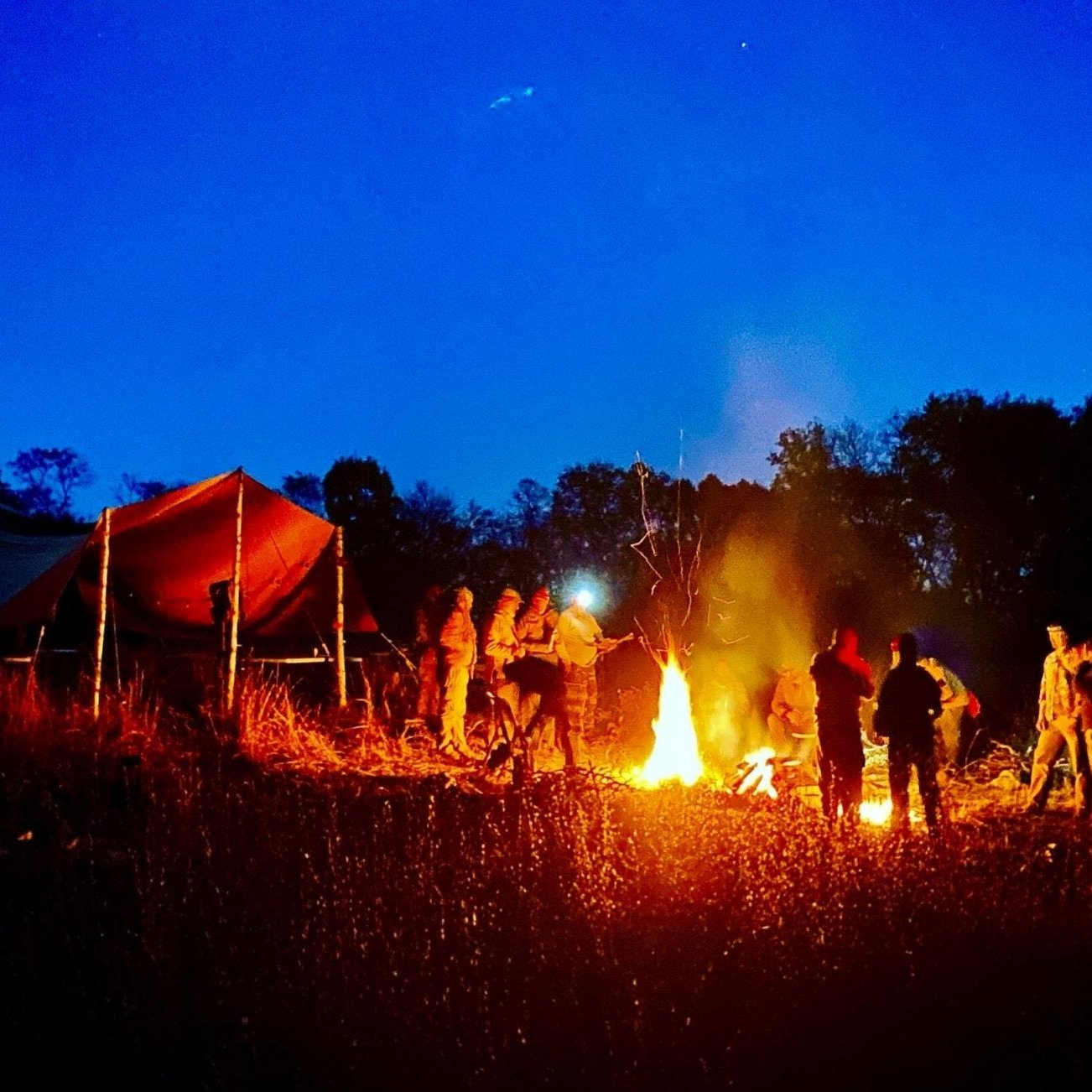
The Gray Bearded Green Beret Wilderness Survival Course is a 3-day, 2-night immersive field course covering the fundamental skills every person needs to survive an unplanned night — or several — in the backcountry. This isn't a camping trip with a survival flavor. Over three days you will learn, practice, and demonstrate fire craft, shelter construction, water procurement and disinfection, emergency signaling, knot work, tool handling, and basic wilderness first aid — all within a structured curriculum built around the 8 Survival Priorities framework Joshua Enyart has taught military and civilian students alike over three decades of professional instruction.

Learn to Survive
Hardcover · Full Color · 430 Pages · by Joshua Enyart
Surviving the Wild is the recommended course companion — 430 full-color pages covering fire, shelter, water, signaling, first aid, and navigation built around the same 8 Survival Priorities framework taught in the field.
Get the Book →The 8 Survival Priorities
Most survival courses teach skills in isolation. The GB2 Wilderness Survival Course teaches them as a system. The 8 Survival Priorities give you a mental framework for decision-making under stress — a sequence that tells you what matters first, what can wait, and why. When your mind is working overtime because something has gone wrong in the field, that framework is what keeps you from making a series of bad decisions that compound on each other.
The priorities aren't a list of tricks. They're a way of thinking that governs everything covered in the course — from why you build a fire before you worry about food, to why shelter location matters more than shelter construction technique when the temperature is dropping. Every skill taught over the three days maps back to this framework, so you leave not just with hands-on experience but with a decision model that applies in any environment and any season.
What You'll Learn Over Three Days
The course runs on a crawl-walk-run instructional model. Every skill is introduced with a full demonstration, practiced with instructor supervision, and then applied in a real-world field scenario before you move on. You don't just watch how to build a shelter — you build one yourself, sleep in it, and know whether it worked. That's the difference between knowing how to do something and having done it.
Fire Craft
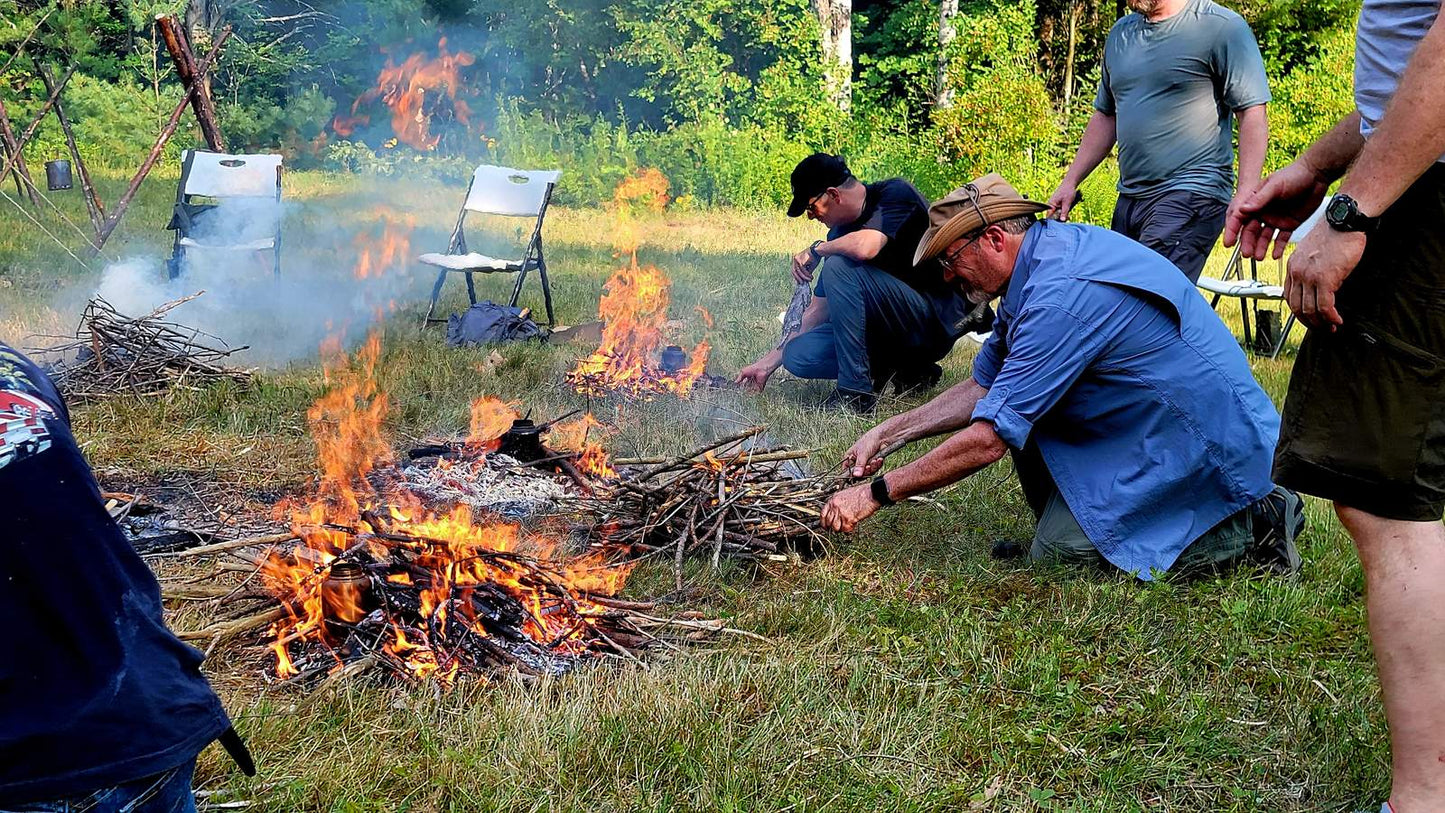
Fire is covered in depth because fire is how you stay alive when everything else has gone sideways. The course covers multiple ignition methods and fuel types — including why redundancy in your fire kit matters and why relying on a single lighter is the kind of assumption that gets people in trouble. You'll work through fire lay selection, fire triangle principles, tinder preparation from natural and processed materials, and the management of fire in varied weather and terrain conditions. Students leave with a fire kit protocol and the hands-on repetitions to back it up.
Shelter and Temperature Regulation
Temperature regulation is the skill most people underestimate until they're in trouble. The course covers shelter construction using natural materials — debris configurations and lean-to structures sized for the terrain and conditions — along with the site selection principles that determine whether a shelter actually works or just looks like it does. Students build and sleep in their own shelters during the 2-night field component. The feedback is immediate and unambiguous: a shelter that doesn't work wakes you up cold at 2 AM, and that's the kind of learning that doesn't require a debrief.
Water Procurement and Disinfection
Finding water is rarely the hard part in a survival situation. Knowing what to do with it — and knowing when you don't have a choice — is where most people's knowledge breaks down. The course covers water sourcing, disinfection methods (boiling, chemical treatment, filtration, and the tradeoffs between them), container improvisation from natural materials, and water consumption strategy under physical and caloric stress. Students work through field scenarios that require locating, collecting, and treating water under realistic conditions.
Emergency Signaling
Getting found is a survival skill. The course covers ground-to-air signals, mirror and reflective signaling, whistle protocols, smoke fire construction for daytime visibility, and the behavioral discipline that keeps people from wandering away from their last known position — a mistake that dramatically increases rescue time and rescue complexity. If you're ever in a position where someone is looking for you, this is the training that gets you found faster.
Knot Work
The course covers the GB2 Knot Progression™ — Joshua's own system for teaching students to build 15 functional knots from just two baseline ties. Most people learn knots by memorizing a list and forget half of them a week later. The Progression teaches the relationships between knots so that the knowledge holds under field conditions, when your hands are cold and your brain is running on something else. Students consistently leave able to tie the full set correctly because they understand the structure, not because they drilled each one in isolation.
Tool Handling
Tool handling covers the belt knife and folding saw — proper grip, cutting mechanics, maintenance under field conditions, and the safety protocols that prevent the most common backcountry injuries. Tool selection philosophy is part of this section: understanding what a cutting tool needs to do in a survival context and what it doesn't, which informs every gear decision before you leave the trailhead.
Wilderness First Aid Basics
The course introduces wilderness first aid at a foundational level — not as a certification track, but as the practical knowledge every person operating in the backcountry needs. Topics include wound management, blister prevention and treatment, improvised splinting, recognition of hypothermia and heat illness, and the decision framework for when to treat in place versus initiate self-evacuation. Students looking to take their medical training further can enroll in the SOLO Wilderness First Aid or SOLO Wilderness First Responder courses offered separately through Gray Bearded Green Beret.
Instructor Credentials and Safety Infrastructure
The Wilderness Survival Course was developed by Joshua Enyart — a former Army Ranger and Green Beret with three decades of professional instructor experience. For civilians looking for military-grade survival training, GB2 is the rare school that actually delivers it: the same foundational methodology Joshua taught to military students, structured for civilian learners at any experience level. Joshua built the GB2 curriculum on the same principles that governed military survival instruction: a specific, sequenced methodology that produces functional competence, not just familiarity. The 8 Survival Priorities framework, the crawl-walk-run progression, and the requirement to demonstrate skills in real field conditions before moving on — all of it reflects the instructional standards he was held to and held others to during his service.
Beyond curriculum, GB2 maintains a safety infrastructure that most civilian survival schools don't match. Every course site operates with an on-site Medic Station with appropriate medical equipment, a dedicated medic and SAR (Search and Rescue) staff member, and instructors who hold CPR/AED certification and are Wilderness First Responder certified at minimum. You are learning field skills in a controlled environment — which means you get real exposure without unnecessary risk. The course is fully insured, and every safety protocol reflects what responsible field instruction actually looks like.
Who This Course Is For
The 3-Day Foundation is designed for anyone who wants a real baseline in wilderness survival — not a surface-level overview, but a working skill set they can apply when it matters. It's the starting point for hunters, hikers, backcountry travelers, overlanders, preppers, and outdoor professionals who want to operate with more confidence and less dependence on technology or external rescue. It's also the entry point for the broader GB2 course curriculum, which builds from the Foundation into progressively more demanding environments and skill sets.
No prior experience is required. The crawl-walk-run structure is designed to bring beginners through to functional competence in three days. Students with prior experience will find the framework approach and the volume of unsupervised field time valuable regardless of what they've done before. The 8 Survival Priorities framework tends to reorganize what experienced students think they know into something more useful.
How This Course Fits the GB2 Curriculum
The Wilderness Survival Course is the foundation for everything else in the GB2 course lineup. Students who complete it move naturally into the Bushcraft Skills Course, which expands on natural material use, camp craft, and primitive fire skills, or into the Winter Survival Course for cold-weather environments and snow shelter construction. The advanced track leads to the Primitive Survival Course — no modern tools, no modern materials, full immersion in traditional skills.
Students who want to study the foundational principles before or after attending the course should look at the Wilderness Survival PDF Series — 13 structured study guides built on the same 8 Survival Priorities framework. For a comprehensive field reference, Joshua's book Surviving the Wild covers the full methodology in 80,000 words and is used by many GB2 students as a primary study reference alongside their course attendance.
Event Status and Travel Policy
Courses listed as "Scheduled" are planned events pending minimum enrollment. Once minimum enrollment is reached, the status changes to "Confirmed" and the course is guaranteed to run. "Confirmed – Limited" indicates only a few seats remain. Students are advised to make travel arrangements only after a course is marked Confirmed. Gray Bearded Green Beret LLC is not responsible for airfare, lodging, rental vehicles, or other travel expenses in the event a Scheduled course does not meet minimum enrollment or must be rescheduled due to circumstances beyond our control.
Course Details and Packing List
The course runs 3 days and 2 nights in a field environment. Multiple dates and locations are available — view all upcoming dates at the Live Training Events page. A full packing list covering required and recommended gear is available for download before you register: Wilderness Survival Course Packing List. Reviewing the list before purchasing is recommended — some gear items benefit from being sourced before arrival rather than acquired last minute. For gear recommendations curated specifically for this course, see the Wilderness Skills Course Gear collection.
Frequently Asked Questions
What survival skills will I learn in the 3-Day Wilderness Survival Course?
The 3-Day Wilderness Survival Course covers the complete GB2 survival curriculum built around the 8 Survival Priorities framework: shelter construction, knots and cordage, fire craft (multiple ignition methods), water procurement and purification, signaling, navigation fundamentals, first aid in the field, and the psychological discipline to execute under stress. Every skill is taught with hands-on field application — you build shelters, make fire, and process water under realistic conditions.
What is the '8 Survival Priorities' framework?
The 8 Survival Priorities is Joshua Enyart's operational decision-making framework for wilderness emergencies — a sequenced model for addressing the most critical threats to life in the correct order. It's the intellectual backbone of everything taught at GB2 and prevents the reactive, scattered behavior that kills people in survival situations. You'll apply it to every scenario throughout the 3 days.
What gear do I need to bring?
The packing list for the course is linked in the product description above. Upon registration you'll also receive the Student Coordination Packet, which includes location details, logistics, and everything you need to prepare.
Is this course appropriate for beginners with no outdoor experience?
Yes. The course is designed for motivated adults with no prior survival training. Joshua builds skills from first principles — starting with mindset and threat assessment before moving into hands-on field skills. If you're physically capable of sustained outdoor activity for 3 days and willing to work hard and get dirty, you're ready for this course.
What makes the GB2 approach to survival training different?
The GB2 System of Training was developed through three decades of field experience and instruction. The focus is on principles over gear — understanding why techniques work so you can adapt them when conditions change, not just following a checklist. These courses are challenging, but they're also genuinely fun — there's no better classroom than the field. No gimmicks, no fluff. Just honest, rigorous training built around skills that actually work.
Do I receive any documentation or certification after the course?
Students who complete the 3-Day Wilderness Survival Course receive a Gray Bearded Green Beret completion certificate and a course patch.
Can families or young adults attend the course?
The course is designed for adults. Children 10 and older may attend with a parent or legal guardian. If you'd like to bring a child under 10, reach out before registering to discuss — approval is handled on a case-by-case basis. All students must be capable of sustained physical activity in variable outdoor conditions for up to 8–10 hours per day.